
On one branch, in one afternoon, Tower Blast! lost 23 authored levels, two mode variants, every level goal, the level map, undo, hearts, the level-select screen, five dialogs and the main menu.
What was left was a rotating tower, a piece, and a score.
That’s the version we shipped toward.
The levels were solving a problem we didn’t have
Levels are genuinely useful. They introduce mechanics, they let you author a specific challenge, and they give progress a staircase you can see.
Ours were doing something else. Every level had an external objective, and the objective kept pulling attention off the board. The question in the player’s head stopped being what is the best move on this tower and became how fast can I finish this errand. A run would start to flow and then stop, because the level had finished its administrative job.
The moment we actually kept coming back to had nothing to do with any of that. Rotate the tower. See a ring almost close. Drop the piece that answers it. Watch the whole structure respond.
So we asked the dangerous production question — what if everything else got out of that moment’s way — and then we did it, which is a different and more expensive thing.
What the levels had been hiding
Taking the structure out exposed every weak transition, which we expected. It also exposed something we didn’t.
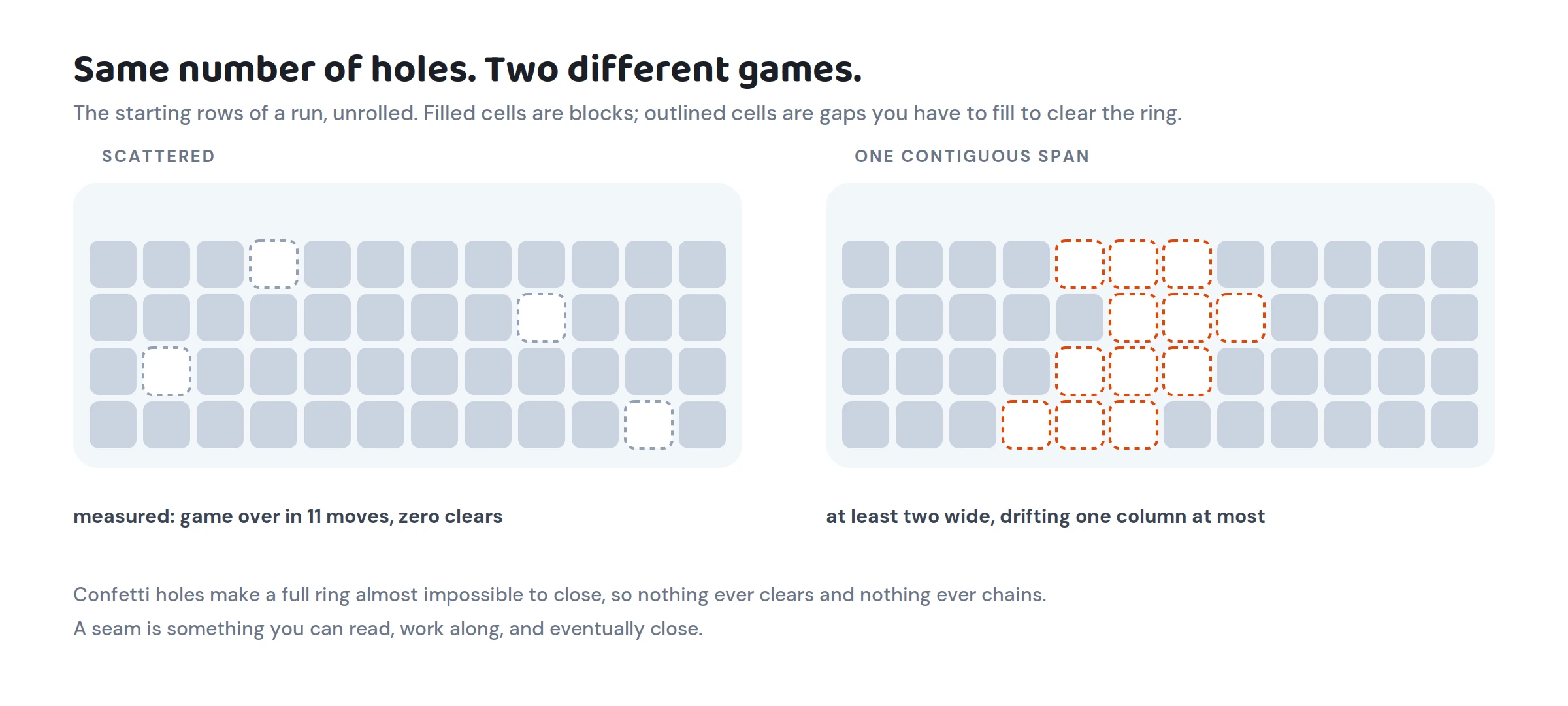
Each run seeds the tower with a few rows of garbage — pre-filled blocks with holes in them, so you start with a shape to work against rather than a blank cylinder. In the level-based game those holes were scattered: one here, one there, wherever the roll landed.
On a ring this wide, scattered single holes are close to uncompletable. You need every gap in a ring filled to clear it, and confetti holes mean the cheapest ring is never actually cheap. The level goals had been carrying the run, so nobody noticed.
Without them, autoplay measured game over in 11 moves with zero clears.
The fix was to stop thinking of the garbage as noise and start thinking of it as a shape. Each row’s holes are now one contiguous span, at least two wide, drifting by at most one column from the row below. It’s a seam through the tower rather than a scatter — something you can read, work along, and eventually close.
What had to be built to replace a structure
Deleting the level system created design work rather than removing it. Without a level-complete screen, the loop has to carry its own momentum, and difficulty has to grow without a staircase to grow on. Three things now do the job the levels used to:
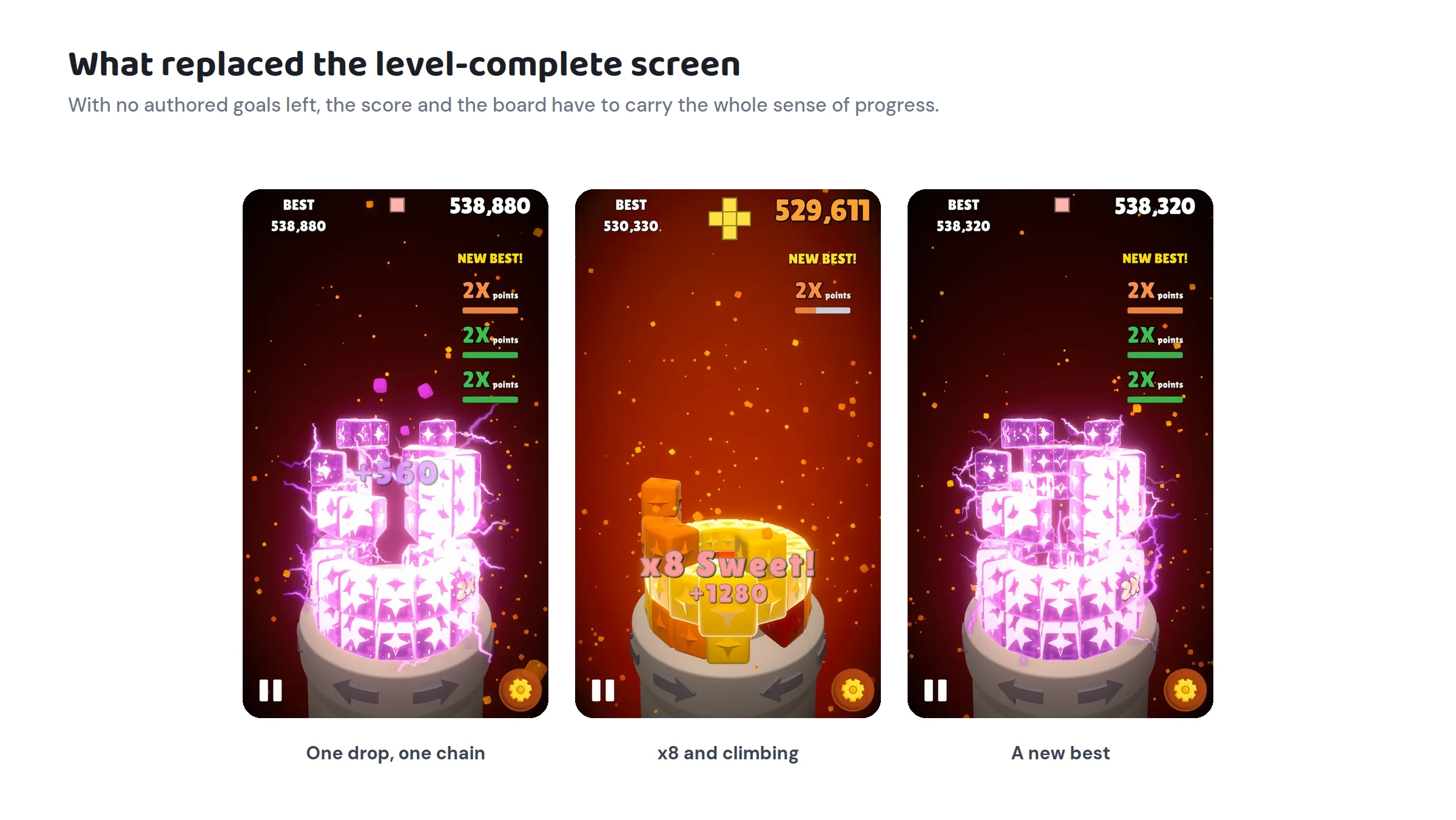
The score is the progression. It isn’t a checklist; it’s a record of how long you kept the system under control. It also feeds the piece selection, so a run gets less forgiving as it gets longer, without any of that appearing as a wall.
The ceiling is visible. A dashed ring marks the height limit and moves when the limit does, so pressure is something you can see coming rather than something you discover.
The clock is soft, and sometimes it lies for you. Each move has a timer, and when it expires the piece drops itself. If that automatic drop would end your run, the game quietly gives you a little more time without saying so — we wrote about why that one is silent.
The old version is still in the history
We kept the tombstone. The level system’s documentation is still in the repo marked as historical, and the old level-design rules file is still sitting at the root with a note on it saying so.
That work wasn’t wasted, and it also wasn’t a lesson about bravery. It was 23 attempts at answering a question, and the answer turned out to be that the question was wrong. The useful signal was behavioural: which interaction did we want to test again after the task was already complete? Which one survived every revision? Which one still felt good with no reward screen explaining that it should?
Same answer three times.
The loop now
Rotate. Read the gaps. Place the piece. Close a ring. Let gravity turn one clear into the next. Watch the sky change when the board comes all the way apart.
No levels. No walls. Just you, the tower, and one more run.
Smaller on paper. Considerably larger in motion.