
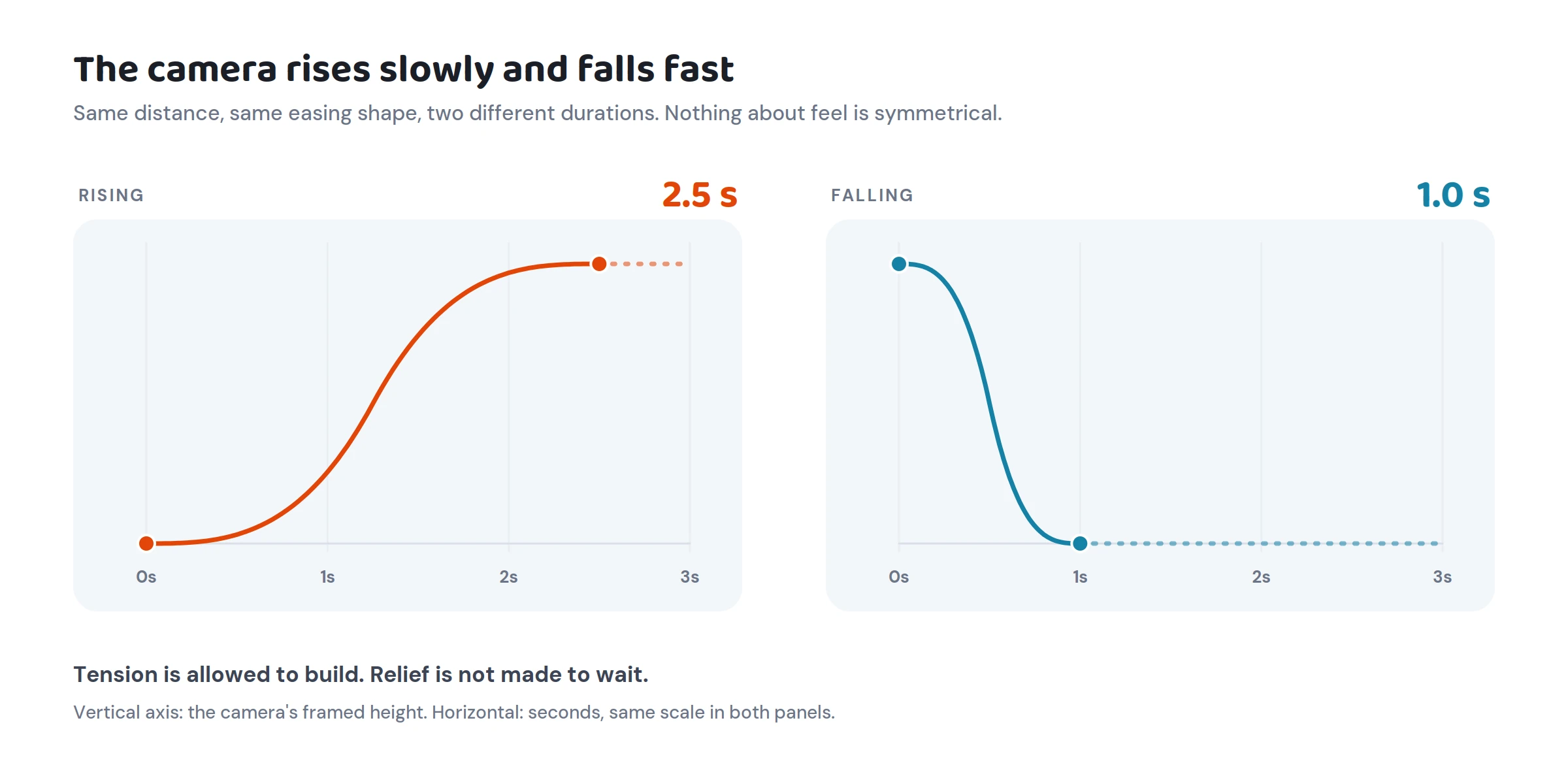
Our camera takes 2.5 seconds to rise and 1 second to fall.
That is not a rounding artifact and it is not a preference. Tension should build slowly enough that you feel the tower getting away from you. Relief should arrive before you’ve finished exhaling. Two numbers, one for each direction, and a player who will never think about either.
Most of what we do is that.
Chip Chill Games is two people — Deniz Şeker on art and animation, me on code — so “we” below is a small room, and every number in it was argued about.
The save you are not told about
Tower Blast! puts a soft clock on each move. When it runs out, the piece drops itself. Usually that’s harmless. Sometimes the automatic drop is the move that ends your run.
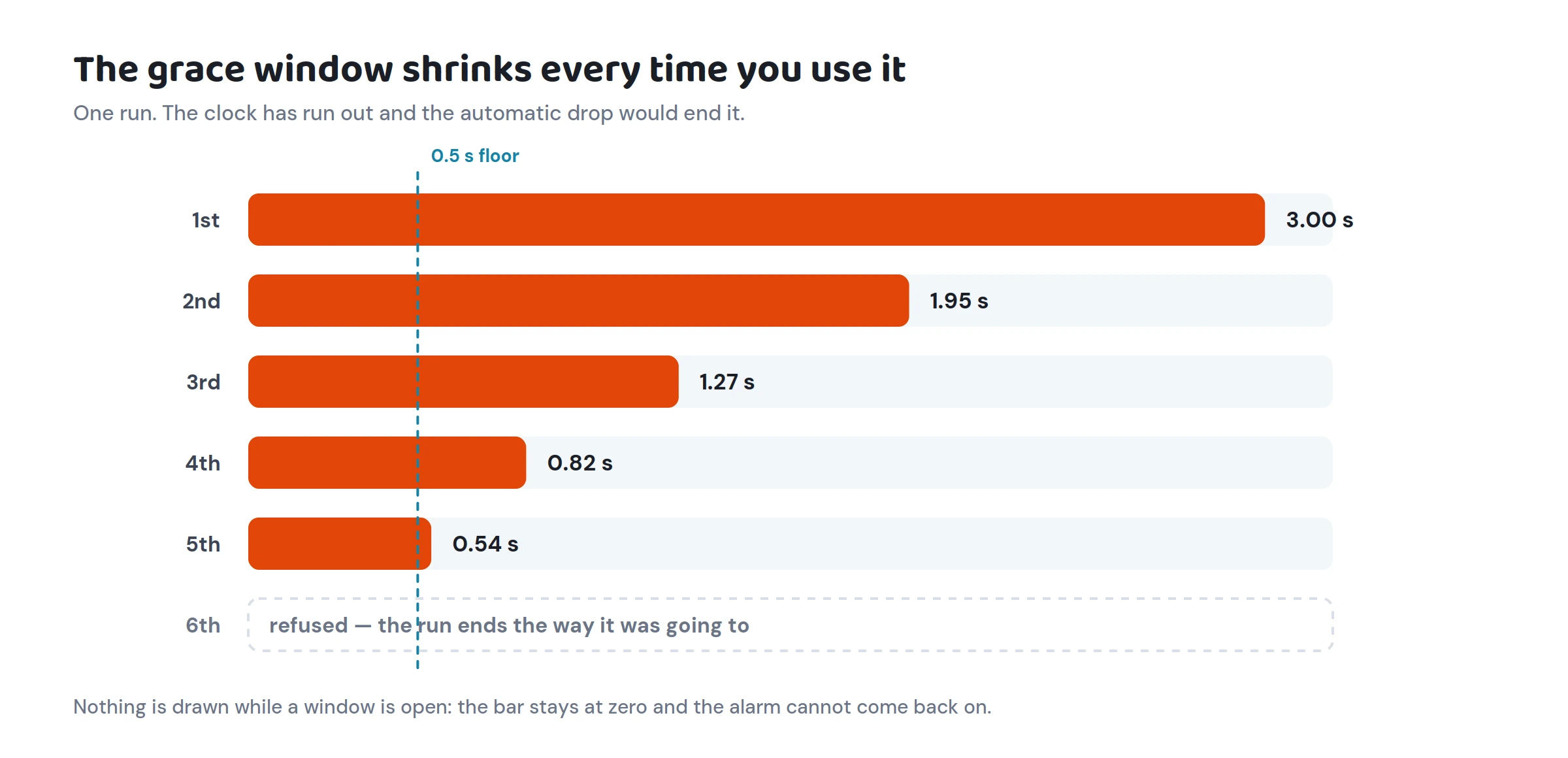
So the game checks. If the drop that is about to happen would end the run, it opens a grace window — and it opens it invisibly. The bar stays at zero. The alarm stays quiet. Nothing writes to the timer while the window is open, so there is no way for the warning to come back on. You make a move, the window closes, and it reads as made it, just.
The budget shrinks every time you use it inside one run:
| Grant | Window |
|---|---|
| 1st | 3.00 s |
| 2nd | 1.95 s |
| 3rd | 1.27 s |
| 4th | 0.82 s |
| 5th | 0.54 s |
| 6th | refused |
We built a visible version of this first. The bar refilled and the alarm re-triggered, which turned a save into an announcement — and an announcement is a thing you can plan around. The quiet one does the same work and stays out of the run.
One number, three feedbacks
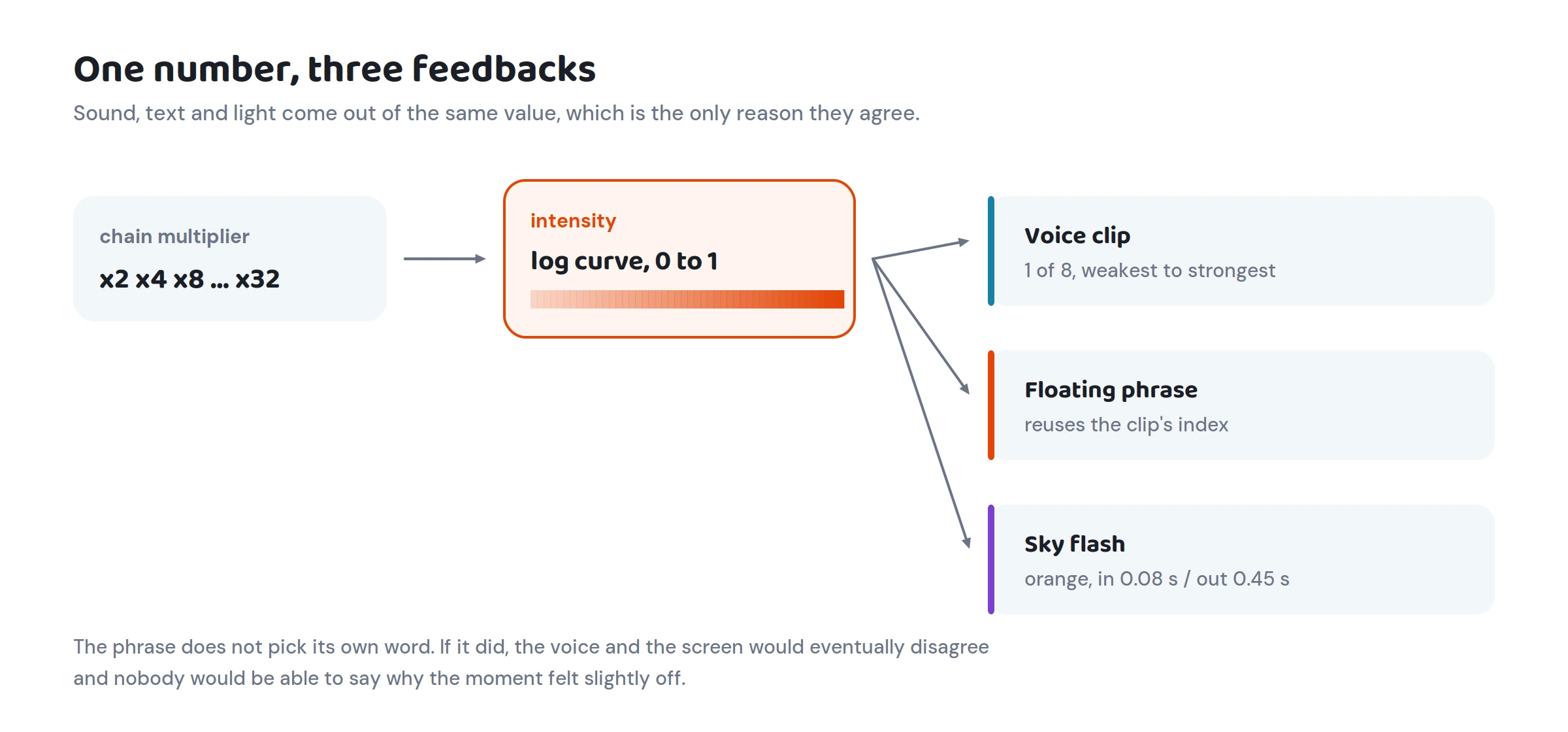
When a chain resolves, the game turns the combo multiplier into a single value between 0 and 1 — a log curve, so x2 and x32 land at opposite ends and everything in between spreads out evenly.
That one value picks three things at once: which of the eight voice clips plays, which word floats up over the tower, and how hard the sky flashes orange.
The floating text reuses the exact clip index rather than picking its own word. It’s a small thing to get right and an annoying thing to get wrong: without it, the voice says one word and the screen says another, and nobody can tell you why the moment felt slightly off.
Land, breathe, then teach
The first run you ever play is the tutorial. There is no separate mode and no separate scene — the game builds a hand-authored board and walks you through five gestures on it.
For a while the tutorial started the moment the scene was ready, which meant the first thing a new player saw was a dim overlay and an instruction, on a board they had never seen. We now wait for the loading curtain to lift, then wait another 0.7 seconds, then teach. The protective half — freezing the clock, clearing leftover visuals — still happens immediately.
0.7 seconds is not a long time. It’s the difference between arriving somewhere and being handed a form.
Where the work actually is
There’s no “make it feel good” task at the end of production. The feel is distributed across a lot of small decisions that each look unimportant on their own:
→ how long a camera takes to come back down → whether a rescue is announced or silent → whether three feedbacks share a source or guess independently → how long the game waits before it starts talking → which of two words a chain gets called
None of these carry the experience. Together they decide whether the game feels generous or fussy.
The name
Turkish has a trick for intensifying an adjective: you take the first syllable, cap it with a consonant, and stick it back on the front. Kırmızı is red; kıpkırmızı is redder than that. There is no equivalent move in English, so we ran an English word through the Turkish rule.
Chip Chill is chill, intensified. The game-chip pun was free.
The chill is engineered.